Wednesday, March 11, 2026

How to Write a CV That Gets You a Job Quickly

How to Write a CV That Gets You a Job Quickly

How to Write a CV That Gets You a Job Quickly

Sarah sat near her desk, staring at a blank screen. Another rejection came in. She had great skills but no one seemed to notice.

After trying new things, she got three interviews in no time. We understand the frustration of searching without results.

how to write a cv that gets you a job quickly

One great CV is like your first impression to recruiters. We'll show you how to write a cv that gets you a job quickly. Our top cv writing tips help you get past automated filters. We want to help you succeed in your career.

Making a CV needs focus on what employers want. Our guide covers everything you need to know. You'll learn about formatting, language, and structure. Get ready for a professional makeover.

Key Takeaways

  • Highlight unique professional achievements clearly.
  • Select clean and modern visual layouts.
  • Align experience with specific job requirements.
  • Ensure contact info stays current.
  • Check grammar for total accuracy.
  • Use active verbs for maximum impact.

1. Understanding What Employers Look for in a CV

In today's job market, knowing what employers want in a CV is key. The job search has changed a lot. Now, many people apply for the same job.

The Modern Hiring Landscape

The hiring process today is very competitive. Technology helps make choosing the right person easier. Employers want to see your skills in professional resume writing. They look for your achievements and what you can do.

professional resume writing

Key Elements That Catch Recruiters' Attention

Recruiters look at many CVs. So, it's important to have key things that make yours stand out. A good CV has clear headings, short descriptions, and the right keywords.

To get resume for job success, make your CV match the job you want. This will help you get noticed.

The Six-Second Rule

Some say recruiters only look at a CV for six seconds before deciding. This might not always be true. But it shows how important it is to make a good first impression.

Your CV should be short, clear, and interesting. Put the most important stuff first. This way, you grab the recruiter's attention right away.

2. Choosing the Right CV Format for Your Situation

To stand out in a competitive job market, pick a CV format that shows off your strengths. The right CV format can really make a difference in how employers see your application.

There are three main CV formats: chronological, functional, and combination. Each has its own benefits and is best for different job seekers.

Chronological CV Format

The chronological CV lists your work experience in reverse order, starting with your latest job. This format is great for those with a steady work history and clear career path.

Key benefits:

  • Emphasizes work history and career progression
  • Preferred by recruiters for its clarity
  • Easy to scan for relevant experience

Functional CV Format

The functional CV focuses on your skills and qualifications, not your work history. It's good for those with employment gaps or changing careers.

Key benefits:

  • Highlights relevant skills and qualifications
  • Downplays employment gaps
  • Ideal for career changers

Combination CV Format

The combination CV combines elements of chronological and functional formats. It shows off your skills and qualifications while also listing your work history in reverse order.

Key benefits:

  • Balances skills and work history
  • Flexible and adaptable to various job applications
  • Allows for highlighting achievements

Which Format Works Best for You

Choosing the right CV format depends on your situation, like your work history, skills, and the job you're applying for. Think about these factors:

  1. Your level of experience in the field
  2. The relevance of your skills to the job
  3. Any gaps in your employment history

By picking the CV format that best shows your strengths and fits your job application, you can boost your chances of landing a job with a great CV.

standout resume

3. Crafting a Powerful Professional Summary

Your CV's professional summary is often the first thing employers see. It's very important. A good summary shows your strengths and makes them want to read more.

What Makes a Summary Effective

A good summary is short, focused, and matches the job you're applying for. It gives a quick look at your professional brand and what makes you special.

Step 1: Identify Your Key Strengths

Think about your best skills and achievements for the job. Look at your past work, what others have said about you, and any big wins.

Step 2: Align Your Summary with the Job Description

Match your summary with the job description by using keywords and phrases from the job. This shows you have the right skills and helps your CV get past ATS.

Step 3: Write a Compelling Opening Statement

Your opening sentence should grab the reader's attention. It should clearly show your professional brand and your biggest achievement or skill.

Here's a comparison to show the difference between a good and bad summary:

Aspect Effective Summary Ineffective Summary
Length Short, about 2-3 sentences Too long, more than 5 sentences
Focus Matches the job description Too general, not job-specific
Language Uses active, dynamic verbs Uses passive voice, vague terms

By following these steps and avoiding common mistakes, you can make a summary that really stands out.

crafting a powerful professional summary

4. Structuring Your Work Experience Section

The work experience section is key in a CV. It shows your skills and achievements. A good section can help you get an interview.

Organizing Your Employment History

How you list your jobs matters. It's important to be clear and logical.

Step 1: List Your Positions in Reverse Chronological Order

Start with your latest job. Then list older jobs in reverse order. This shows your career growth.

For example, a marketing pro with five years of experience might list:

  • Marketing Manager, XYZ Corporation (2020-Present)
  • Marketing Coordinator, ABC Company (2018-2020)
  • Marketing Assistant, DEF Agency (2017-2018)

Step 2: Use Action Verbs to Describe Your Responsibilities

Use words like "managed," "created," and "improved." This makes your job sound exciting.

Instead of "was responsible for managing a team," say "managed a team of 10 people, increasing productivity by 25%." This shows your skills and achievements.

Step 3: Quantify Your Achievements with Numbers and Metrics

Use numbers to show your achievements. This could be percentages, dollar amounts, or other metrics.

Job Title Achievement Metric
Sales Manager Increased sales revenue 30% within 6 months
Marketing Coordinator Boosted social media engagement 500% through targeted campaigns
Project Manager Completed projects ahead of schedule 95% on-time delivery rate

Handling Employment Gaps

Employment gaps can worry job seekers. Be honest and positive about them. Mention any skills or experiences gained during that time.

If you took a break to care for a family member, talk about skills like time management or multitasking.

By following these tips, you can make your work experience section strong. It will show your skills and achievements, helping you get interviews.

5. Highlighting Your Skills and Competencies

To stand out, highlight your skills and competencies in your CV. Employers want candidates with the right skills, not just qualifications.

Highlighting your skills effectively can make a big difference. It's not just about listing them. It's about showing how they fit the job.

Hard Skills vs. Soft Skills

It's important to know the difference between hard and soft skills. Hard skills are technical, like programming or marketing. Soft skills are about how you work and interact, like teamwork or problem-solving.

As a career expert says,

"The most successful candidates are those who can demonstrate a balance of both hard and soft skills."
Career Expert

Step 1: Identify Industry-Relevant Skills

First, find the skills needed in your industry. Look at job descriptions and online resources. This will help you know what skills are important.

Step 2: Match Skills to Job Requirements

Next, match your skills to the job you want. Tailor your CV for each job. Use the job's language to describe your skills. This helps your CV pass through ATS and catch the hiring manager's eye.

Step 3: Organize Skills for Maximum Impact

How you organize your skills matters. Use a skills summary and a detailed list. Bullet points make your skills pop. Be specific about your skill level.

  • Identify your key skills and group them into categories.
  • Prioritize the skills most relevant to the job.
  • Use action verbs to describe your skills, such as "Proficient in," "Experienced with," or "Skilled at."

By following these steps, you can make your skills section stand out. This increases your chances of getting noticed by employers.

6. Optimizing Your CV for Applicant Tracking Systems

Many companies use Applicant Tracking Systems (ATS) to find the right candidates. It's key to make your CV ATS-friendly. This means using the right keywords and formatting to get past these digital filters.

How ATS Software Works

ATS software reads and analyzes CVs. It looks for keywords and phrases to see if you fit the job. This helps employers find the best candidates.

Key Features of ATS Software:

  • Parses CVs into a database for easy searching
  • Matches CVs against job descriptions using keywords
  • Ranks candidates based on their relevance to the job

Step 1: Use Standard Section Headings

Use common section headings like 'Work Experience' and 'Education'. This helps ATS software understand your CV better.

Step 2: Incorporate Relevant Keywords

Use keywords from the job description in your CV. This makes your CV more visible to ATS. Look for key words and phrases in the job posting.

For example, if the job wants "project management skills" and "team leadership," put those in your CV if you have them.

Step 3: Avoid ATS-Unfriendly Formatting

Some formatting can confuse ATS software. Avoid images, tables, and too many graphics. Keep your layout simple and easy to read.

ATS-Friendly ATS-Unfriendly
Simple fonts like Arial or Calibri Unusual or decorative fonts
Standard headings like 'Work Experience' Creative headings or graphics
Bullet points for lists Tables or images for lists

Testing Your CV for ATS Compatibility

Test your CV with ATS software or online tools. This shows if it's ATS-friendly. Make changes to improve its chances.

By following these tips, you can make your CV ATS-friendly. This boosts your chances of getting noticed. It's a big step towards resume for job success.

7. How to Write a CV That Gets You a Job Quickly by Tailoring It to Each Position

In today's job market, a custom CV is key. Many people apply for the same job. A generic CV gets lost. To land a job with a great CV, you must tailor it.

Why Generic CVs Fail

Generic CVs don't match the job well. They miss the job's specific needs and keywords. This makes them hard to find by hiring managers.

Here are some common mistakes of generic CVs:

  • Lack of relevant keywords
  • Failure to address specific job requirements
  • Inability to showcase achievements relevant to the position

Step 1: Analyze the Job Description Thoroughly

Start by really looking at the job description. Find the key skills and qualifications needed. This helps you show how you fit the job.

For example, if the job wants project management skills, show your experience. Talk about your successes and challenges.

Step 2: Mirror the Language Used in the Posting

Use the same words as the job posting. Don't copy it, but use its key phrases. This is important in your summary and skills section.

For instance, if the job talks about data analysis, use that term in your CV. Describe your skills and experience with it.

Step 3: Prioritize Relevant Experience

Focus on the experience that matches the job. You might change the order of your work history. Highlight roles that fit the job well.

For a marketing job, focus on your social media and campaign work. Show your experience in these areas.

Creating a Master CV for Easy Customization

Make a master CV with all your experiences and skills. Then, customize each CV for each job. This saves time and keeps your professional history ready for any job.

By following these steps, you can make your CV stand out. This boosts your chances of getting the job you want.

8. Presenting Your Education and Certifications

When making a job-winning CV, it's key to show your education and certifications well. This part can really help you get noticed, more so for new graduates or those starting a new career.

When to Put Education First

If you're new to the job market or in a field where your education matters a lot, put your education first. This way, the hiring manager sees your qualifications right away.

Step 1: List Your Degrees and Institutions

Begin with your highest degree, then list lower degrees in reverse order. Include the school name, degree, and when you were there. For example:

Degree Institution Dates Attended
Master's in Business Administration Harvard Business School 2018-2020
Bachelor's in Economics Stanford University 2014-2018

Step 2: Include Relevant Coursework and Honors

Highlighting relevant coursework and achievements can make your education section better. If you took courses related to the job, list them. Also, add any honors or awards you got.

For instance, for a data science job, mention "Machine Learning" or "Data Mining" courses.

Step 3: Add Professional Certifications and Training

Professional certifications and training are as important as formal education. List any certifications, the organization, and when you got them. This shows you're always learning and growing.

By following these steps, you can make a strong education and certifications section. This will help your CV stand out and increase your chances of getting hired.

9. Designing a Clean and Professional CV Layout

To get an interview, your CV must look clean and professional. A good CV shows your skills and experience. It also shows you pay attention to details and can present info well.

Visual Appeal Matters

The look of your CV matters a lot. A messy CV can scare off recruiters. But a neat and organized CV makes a good first impression.

Key Elements of Visual Appeal:

  • Appropriate font choices
  • Effective use of white space
  • Consistent formatting

Step 1: Choose Appropriate Fonts and Spacing

Picking the right fonts and spacing is key. Use fonts like Arial, Calibri, or Helvetica in size 10 or 11 points. Good spacing makes your CV easy to read and highlights key points.

Tip: Use font sizes 12 or 14 points for headings. This makes your CV easy to scan.

Step 2: Use White Space Effectively

White space, or empty space, makes your CV look better. It makes your CV easy to scan. Don't pack your CV with too much text or elements.

Step 3: Maintain Consistent Formatting Throughout

Keep your CV's formatting the same. Use the same font, spacing, and bullet points everywhere. This makes your CV look polished and easy to read.

One Page or Two: Making the Right Choice

Choosing between a one-page or two-page CV depends on your experience and the job. Entry-level jobs often need a one-page CV. More experienced people might need two pages to show off their skills.

Consider the following when deciding:

  • Relevance of your experience to the job
  • The amount of relevant information you need to include
  • The preferences of your industry

By following these tips, you can make a CV that stands out. It will show your skills and experience in a clear, professional way. This will help you succeed in your job search.

10. Avoiding Common CV Mistakes That Cost You Interviews

Making a CV that gets noticed means showing your skills and avoiding mistakes. We'll look at common errors that can hurt your CV. We'll also tell you how to dodge them.

Spelling and Grammar Errors

Spelling and grammar mistakes can hurt your reputation. They can make a bad first impression. To fix this, proofread your CV many times and use tools to check grammar and spelling.

It's smart to have someone else look at your CV too. They might find mistakes you missed. A perfect CV is key to a good first impression.

Including Irrelevant Information

Putting in info that's not needed can mess up your CV. To fix this, make your CV fit each job you apply for. Focus on skills and experiences that match the job.

Get rid of old or useless parts of your CV. This makes your CV clear and focused. It shows you're right for the job.

Using Passive Language

Passive language makes your achievements seem less important. Use action verbs like "managed," "created," "developed," and "improved" to talk about your work.

This makes your CV more lively and shows you're active and accomplished.

Outdated or Unprofessional Contact Information

Make sure your contact info is current and professional. Don't use bad email addresses or old phone numbers.

Get a professional email for job hunting if you need to. Also, make sure your voicemail sounds good and can take messages.

Overused Buzzwords Without Substance

Using common buzzwords without real examples makes your CV seem empty. Instead of saying "team player" or "results-driven," give real examples of these traits.

For example, say you worked with a team to reach a big goal. This shows you're different from others and proves your worth.

11. Conclusion

Writing a CV that gets you a job quickly needs a smart plan. You must know what employers want. Then, pick the right CV format and tailor your application for each job.

Good professional resume writing is more than just listing your jobs and skills. It's about showing them in a way that employers will like. A strong professional summary, well-organized work experience, and the right skills make your CV stand out.

By using the tips from this article, you can make a CV that gets past applicant tracking systems. It will also grab the attention of hiring managers. A well-made CV brings you closer to getting an interview and your dream job.

FAQ

How do we determine the best CV format for our specific career stage?

The right format depends on our job history. A chronological CV is best for steady work in one field. But, if we're changing careers or have gaps, a functional or combo CV highlights our skills.

Choosing the right format is key. It makes sure our experience is seen first.

What are the most effective resume writing strategies to pass through Applicant Tracking Systems (ATS)?

To beat ATS, use standard headings and job keywords. Avoid graphics and weird fonts. Our resume should be easy for both machines and people to read.

How can we create a compelling cv summary that grabs a recruiter’s attention in six seconds?

Our summary must be short and to the point. List our top strengths and match them with the job's needs. Use action verbs and specific achievements to stand out.

A good summary is like an elevator pitch. It makes the recruiter want to read more.

Why is quantifying achievements so important for resume for job success?

Numbers show our impact. Instead of just listing jobs, use metrics like "increased sales by 20%". The Google XYZ formula proves our value with data.

How do we handle employment gaps without hurting our chances of getting an interview?

Be honest about gaps. Mention them briefly in your cover letter or CV. A combo CV focuses on our skills, not just dates.

What is the most common mistake we should avoid to ensure a standout resume?

Don't use a generic CV. Tailor your CV to each job. Avoid spelling mistakes and outdated info. A custom CV shows you're interested in the role.

Should our CV be one page or two pages long?

A one-page CV is best for most. But, if you have lots of experience or certifications, two pages is okay. Keep it clean and focused.

How do we effectively present our education and certifications to enhance our professional resume writing?

Recent grads should list education first. For others, work experience comes first. Include certifications to show you keep learning and are an expert.

2026 Scholarships Abroad: A Step-by-Step Application Guide

2026 Scholarships Abroad: A Step-by-Step Application Guide

2026 Scholarships Abroad: A Step-by-Step Application Guide

Many students miss out on scholarships because they're late. This how to apply for scholarships abroad step by step guide 2026 helps every student.

how to apply for scholarships abroad step by step  guide 2026

The scholarships abroad application process needs careful planning. Getting money can change your school life. We offer tools to help you.

If you need help, email jumanjisaexplore@gmail.com. Our team will guide you. Let's make your dream of studying abroad come true.

Key Takeaways

  • Start early and meet deadlines.
  • Research diverse financial aid options.
  • Prepare excellent application documents.
  • Request professional help via email.
  • Maintain organization throughout the cycle.
  • Confirm all entry requirements carefully.

Understanding Scholarship Opportunities for Studying Abroad in 2026

Students planning to study abroad in 2026 need to know about international scholarships. There are many scholarships out there. It's important to know what scholarships are available, who can apply, and when to apply.

Types of International Scholarships Available

There are different kinds of scholarships for studying abroad in 2026. Mert-based scholarships go to students who do well in school. Need-based scholarships help students who need money.

Some scholarships are for students from certain countries. These help with cultural exchange. Others are for specific subjects or programs.

international scholarships

Eligibility Requirements and Criteria

What you need to qualify for scholarships varies. It often includes your grades, language skills, and sometimes special talents.

Here's a table with common requirements:

Eligibility Criteria Description Typical Requirements
Academic Performance Academic achievements and records GPA, academic awards, transcripts
Language Proficiency Proficiency in the language of instruction TOEFL, IELTS scores
Specific Skills or Talents Special talents or skills relevant to the field of study Portfolios, auditions, or specific certifications

Application Timeline for 2026 Programs

Knowing when to apply is key. For 2026, most scholarships open in September and December 2025.

Make a plan to keep track of deadlines. This includes when to apply, get letters of recommendation, and take tests.

For more info on scholarships, email us at jumanjisaexplore@gmail.com.

How to Apply for Scholarships Abroad Step by Step Guide 2026

To apply for scholarships abroad in 2026, follow these steps. This guide will help you increase your chances of getting a scholarship.

Step 1: Research and Identify Suitable Scholarship Programs

Start by finding scholarships that match your academic goals.

Search Reputable Scholarship Databases and Platforms

Look for scholarships on trusted websites. ScholarshipOwl and InternationalScholarships.com have lots of options.

Match Your Academic Profile to Scholarship Requirements

Check each scholarship's criteria. Make sure your grades and goals fit.

Create a List of Target Scholarships

Make a list of scholarships you want to apply for. This keeps you organized.

scholarship application process

Step 2: Gather and Prepare Required Documents

Getting your documents ready is key.

Obtain Official Academic Transcripts and Certificates

Get your transcripts and certificates from school. They should show your grades well.

Request Letters of Recommendation Early

Ask people you know for letters of recommendation early. Give them info about the scholarship and your achievements.

Prepare Proof of Language Proficiency

If needed, get language test scores. Make sure they meet the scholarship's needs.

Collect Financial Documents if Required

Some scholarships need financial info. Get bank statements or proof of income if asked.

Step 3: Write Your Personal Statement and Essays

Your personal statement and essays are very important.

Understand the Essay Prompts Thoroughly

Read and understand the essay prompts well. Plan your answers carefully.

Highlight Your Academic Achievements and Goals

Use your essays to talk about your grades and goals. Show how the scholarship will help you.

Demonstrate Your Fit for the Program

Show you're a good match for the scholarship. Align your interests and goals with the program's.

Step 4: Complete and Submit Your Applications

Now, it's time to finish and send in your applications.

Fill Out Application Forms Accurately

Fill out the forms carefully. Make sure all info is right and complete.

Upload All Required Documents

Upload all needed documents. This includes transcripts, letters, and language test scores.

Submit Before Deadlines and Keep Confirmations

Send in your applications before the deadlines. Keep proof of submission for your records.

For more help on applying for scholarships abroad, email us at jumanjisaexplore@gmail.com.

Tips for Increasing Your Scholarship Approval Rate

To get study abroad scholarships, you need a smart plan. Show your best and meet each scholarship's needs. This way, you can get money for your international studies.

Tailor Each Application to Specific Scholarship Goals

Make your application fit each scholarship's goals. Know what the scholarship wants and make your essays match. This shows you really want the scholarship.

scholarship application process

Proofread and Edit All Application Materials

A good application is key. Check your essays and personal statement many times. Get help from teachers or friends to make it perfect.

Apply to Multiple Scholarships to Improve Your Odds

Don't rely on just one scholarship. Applying to many scholarships boosts your chances. Look for scholarships that match you and apply to them all. This can really help you get money.

Seek Professional Guidance and Support

Get help from experts to make your application better. Email us at jumanjisaexplore@gmail.com for help. Experts can give you great tips and help you avoid mistakes.

Conclusion

Getting a scholarship to study abroad can change your life. This article shows you how to apply step by step. It's all about planning, researching, and making a great application.

To get a scholarship in 2026, know what scholarships are out there. Make sure you meet the requirements. Our guide helps you apply with confidence.

Need more help or have questions? Contact us at jumanjisaexplore@gmail.com. We're here to help you with your studies.

FAQ

What is the first stage of the how to apply for scholarships abroad step by step guide 2026?

First, do a lot of research. Look for programs that fit your academic goals. Use sites like Scholarships.com or the Fulbright Program website. For help, email our experts at jumanjisaexplore@gmail.com.

When should I begin the process of applying for scholarships overseas 2026?

Start 12 to 15 months before your program starts. Big awards like Chevening Scholarships have early deadlines. This gives you time to improve your essays or retake tests.

What are the most important documents needed for the scholarships abroad application process?

You'll need official academic transcripts and test scores like the GRE or SAT. Also, proof of English skills with IELTS or TOEFL, and strong letters of recommendation. Our guide stresses getting these early to meet deadlines.

Do you have any specific international scholarships application tips to increase my success rate?

Tailor your personal statement to the scholarship's mission. Show how your goals match the values of groups like the Gates Cambridge Trust. For a review, contact jumanjisaexplore@gmail.com.

Can I apply for more than one award using this step by step scholarship application abroad?

Yes, applying to several programs is a good strategy. Aim for a mix of big government scholarships and smaller grants from universities. This increases your chances of getting financial help.

What are the essential study abroad financial aid steps for students with high financial need?

Look for "need-based" scholarships for international students. You might need to share financial details or tax returns. Accurately following the study abroad financial aid steps is key for full-ride awards. For a list of need-based providers, email jumanjisaexplore@gmail.com.

How do I ensure my essay stands out in the overseas scholarships application guide?

Share your unique story and leadership skills. Scholarship committees at places like Stanford University or the University of Oxford want to see your community impact. Use our guide to write a clear essay that shows your achievements and goals.

Discover the Best Scholarships for African Students in 2026

Discover the Best Scholarships for African Students in 2026

Discover the Best Scholarships for African Students in 2026

I remember a friend's quiet hope for his future. He had the drive but not the money for a global university. This inspired me to find the best scholarships for African students.

Talent is everywhere, but funding isn't always there. My goal is to help you reach your dreams. Finding top scholarships for African students in 2026 is key for many leaders.

top scholarships for african students in 2026

I'm here to help you through every step. If you need help, email us @ jumanjisaexplore@gmail.com. We'll get you the vital resources you need for success.

Key Takeaways

  • Identify fully funded programs early in the year.
  • Focus on specific eligibility criteria for each grant.
  • Prepare strong personal statements that reflect your journey.
  • Network with current award recipients for insider tips.
  • Meet all submission deadlines to remain competitive.
  • Access professional mentorship through our email network.

Why I Believe 2026 Represents a Breakthrough Year for African Student Funding

2026 looks like a big year for African student funding. More money will go into education worldwide. This is because of more scholarships, better partnerships, and a big push for African talent.

New scholarship programs are coming in 2026. Groups like the Mastercard Foundation and the African Union will offer more chances. Dr. Bingu wa Mutharika, former Chairperson of the African Union, said, "Education is the key to unlocking the African continent's future."

"The future of Africa lies in the hands of its youth, and education is the cornerstone of their success."
Dr. Nkosazana Dlamini-Zuma, Former Chairperson of the African Union Commission

More partnerships are forming between global groups and African schools. These partnerships bring more scholarships and chances for research. For example, the African Leadership University offers scholarships that cover everything.

A vibrant and hopeful scene depicting a diverse group of African students enthusiastically engaging in discussions about scholarships and funding opportunities for 2026. In the foreground, a young woman in professional business attire reads from a notepad, surrounded by a diverse group of students dressed in modest but stylish clothes, all focused and engaged. The middle ground features a modern university campus with students walking and interacting, symbolizing a thriving academic environment. In the background, a bright sunny sky casts a warm glow over the scene, enhancing the feeling of optimism and opportunity. The atmosphere is inspiring and educational, emphasizing the breakthrough potential of funding in 2026 for African students. The logo of "jumanjisa scholars" subtly integrated into the campus architecture. High-resolution, vibrant colors, natural lighting.
Scholarship Name Eligibility Award
Mastercard Foundation Scholars Program High school graduates from sub-Saharan Africa Full tuition, accommodation, and books
African Union Scholarship Program African students pursuing undergraduate or graduate studies Tuition fees, living expenses, and research grants
Mandela Rhodes Foundation Scholarship Young African leaders with a strong academic record Full scholarship for postgraduate studies, leadership development

In conclusion, 2026 is a big year for African student funding. With more programs and new ones, African students have more chances for education. I'm excited to see what the future holds for African education.

Top Scholarships for African Students in 2026: My In-Depth Analysis

In my study of 2026 scholarships for African students, I found some great programs. They will greatly help the education in Africa.

I looked at these chances closely. I checked their rules, who can apply, and what benefits they offer. Let's start with a very important program.

Mastercard Foundation Scholars Program: A Case Study in Transformative Education

The Mastercard Foundation Scholars Program is a big hope for many African students. It gives more than just money to help.

Program Structure and Financial Coverage

This scholarship covers all tuition, living costs, and more. It lets students study without worrying about money.

Key Components of the Mastercard Foundation Scholars Program:

Component Description
Tuition Fees Full coverage of tuition fees
Accommodation Full accommodation support
Other Expenses Support for books, uniforms, and other essential expenses

Success Rates and Student Outcomes I've Observed

The Mastercard Foundation Scholars Program has a great success rate. It makes students into leaders in their fields.

The program focuses on growing character and leadership skills.

Eligibility Requirements and Partner Universities

To apply, students need to be smart, show leadership, and want to help their communities.

The program works with top universities in Africa. Students get to learn and experience different cultures.

A vibrant, empowering scene showcasing a diverse group of African students gathered in a modern educational setting, representing the concept of scholarships for 2026. In the foreground, a confident female student in professional business attire smiles while holding a scholarship brochure labeled “Jumanjisa Scholars.” Beside her, a male student in smart casual clothing is enthusiastically discussing opportunities with his peers. In the middle, a round table filled with scholarship application materials, laptops, and books symbolizes collaboration and ambition. The background features large windows letting in warm, natural light, with an inspiring mural of African landscapes and cultural symbols. The overall atmosphere conveys hope, determination, and a bright future for African students pursuing higher education through scholarships.

African Union Scholarship Program: My Assessment of Continental Opportunities

The African Union Scholarship Program also caught my eye. It aims to boost learning and unity across Africa.

Scholarship Scope and Participating Nations

This program is for students from all African Union countries. It's a chance for students to share and learn from each other.

Field-Specific Funding I've Identified

The program helps students in many areas. This includes science, technology, engineering, and mathematics (STEM), and social sciences and humanities.

Fields Eligible for Funding:

  • STEM disciplines
  • Social sciences
  • Humanities

Mandela Rhodes Foundation Scholarship: My Analysis of Leadership Development Focus

The Mandela Rhodes Foundation Scholarship aims to grow the next African leaders. It focuses on building character and community involvement.

What Makes This Scholarship Unique

This scholarship is special because it focuses on leadership. It gives students the tools and guidance to make a difference.

Application Timeline and Selection Criteria

The application opens in the first quarter of the year. The selection is tough, with interviews and tests.

If you're interested, contact the foundation for the latest on when and how to apply.

Email jumanjisaexplore@gmail.com to join our support network for more help with scholarship applications.

My Personal Framework for Maximizing Your Scholarship Application Success

Getting a scholarship needs a smart plan. I've made a plan to help African students get financial aid for African students and scholarships for African nationals.

Success comes from being thorough and smart in your application. My plan focuses on getting ready, timing, and getting help.

Essential Documents I Recommend Preparing Now

Start by getting your important documents ready early. You'll need:

  • Academic transcripts and certificates
  • Personal statement or essay
  • Letters of recommendation
  • Proof of language skills (like TOEFL or IELTS scores)
  • Any extra documents the scholarship asks for
A diverse group of African students in professional business attire, intently collaborating at a table covered with scholarship brochures and laptops, showcasing determination and ambition. The foreground features a close-up of students engaged in discussion, with eager expressions and open documents, symbolizing scholarship opportunities. In the middle, a laptop screen displays the logo "jumanjisa scholars," emphasizing their commitment to supporting African students. The background reveals a bright, well-lit study environment filled with bookshelves, academic posters, and motivational quotes about success. Natural light streams through a large window, creating an inspiring and uplifting atmosphere. The overall mood is focused and hopeful, capturing the essence of maximizing scholarship application success in 2026.

Strategic Timeline I've Developed for 2026 Applications

Having a plan is key to not missing deadlines. Here's a plan I find helpful:

  1. 6-12 months before the deadline: Look for and pick scholarships
  2. 3-6 months before the deadline: Get your documents ready
  3. 1-3 months before the deadline: Send in your applications

Make sure to adjust this plan for each scholarship's needs.

Join My Support Network: Email jumanjisaexplore@gmail.com

Need help or support? Email jumanjisaexplore@gmail.com to join my network. Sharing experiences and getting advice can help a lot.

Stick to my plan and keep your goals in mind. You can increase your chances of getting a scholarship. Good luck with your studies.

Conclusion

Looking ahead to 2026, it's a big year for African student funding. Many scholarships are available for students to follow their dreams.

The Mastercard Foundation Scholars Program, African Union Scholarship Program, and Mandela Rhodes Foundation Scholarship are key. They can change students' lives. Knowing what documents you need and planning well can help you succeed.

I urge all students who qualify to check out these scholarships for 2026. It's a chance to start your academic journey. This could lead to a better future for you.

FAQ

What are the top scholarships for african students in 2026?

The Mastercard Foundation Scholars Program, Mandela Rhodes Foundation Scholarship, and African Union Scholarship Program are the best. They offer full tuition, living stipends, and leadership training.

Why is 2026 considered a breakthrough year for african student funding 2026?

2026 is special because of new partnerships. The African Union and international schools are working together. This means more african student grants 2026 in fields like renewable energy and digital health.

Who is eligible for the Mandela Rhodes Foundation Scholarship?

This scholarship is for scholarships for african nationals with great leadership and academic skills. You must be from an African country and under 30. It's a top choice for leadership development and study.

What are the main benefits of the Mastercard Foundation Scholars Program?

This program offers a full package for 2026 african student scholarships. It covers tuition, books, and more. But its best part is the career mentorship and alumni network.

When should I begin the application process for scholarships for africans?

Start preparing 12 to 15 months before you want to start. For the top scholarships for african students in 2026, get your documents ready by early 2025.

How can I improve my chances of securing african student grants 2026?

Focus on how your studies will help your community. For help and a timeline, email us @ jumanjisaexplore@gmail.com.

Are there specific fields of study favored by the African Union Scholarship Program?

Yes, the African Union likes STEM and Social Sciences. These fields are more likely to get you african student funding 2026.

Best Free Apps Every Student Should Use in 2026

Best Free Apps Every Student Should Use in 2026

Best Free Apps Every Student Should Use in 2026

Did you know students now spend over five hours daily on mobile devices for school? Your phone is now a powerful academic powerhouse for modern learners. It helps you do better in school.

best free apps every student should use in 2026

We think you can do well in school without spending a lot. That's why we're looking at the best free apps for 2026. These apps help you manage your time and grades better.

Start today with us and learn everyday. See how digital tools can change your routine. These tools help you stay organized and focused on important things.

Using these tools, you can focus on your future without worrying about money. We'll show you the latest tech that makes learning easier. Let's explore the tools that will help you succeed in school.

Key Takeaways

  • Discover mobile tools that cost nothing for your daily studies.
  • Improve organization through sophisticated digital calendars and planners.
  • Boost productivity with smart note-taking software and automation.
  • Enhance collaboration with seamless cloud-based sharing features.
  • Achieve academic goals without spending money on expensive licenses.
  • Simplify study habits using modern technology and intuitive interfaces.

Why We Recommend These Essential Student Apps for 2026

We're excited to share our top picks for free student apps in 2026. These tools help students be more productive and do well in school. We want to help students use the best technology.

We looked at many apps to find the best ones. We checked their features, what users say, and if they meet different student needs.

"Technology will continue to shape the way we learn and teach. The right tools can make a big difference in a student's learning and goals."

We analyzed many apps to see if they help students learn better and do school work easier. We chose apps that are easy to use and work well for everyone.

App Category Key Features User Reviews
Note-Taking Apps Organization, tagging, and search functionality 4.5/5
Productivity Apps Task management, reminders, and focus-enhancing tools 4.7/5
Study and Learning Apps Interactive content, quizzes, and progress tracking 4.8/5

By starting today, students can use these free student apps 2026 and learn every day. We think the right tech can really improve school life.

recommended student apps 2026

Our picks are a good start for students wanting to use tech in their studies. By trying these apps, students can find new ways to stay organized and reach their goals.

Best Free Apps Every Student Should Use in 2026

In 2026, students have many free apps to help them learn. It's hard to pick the best ones. We'll look at the must-have student apps 2026 that can really help with school.

Note-Taking and Organization Apps

Good note-taking and staying organized are key for doing well in school. Here are some top picks:

Notion

Notion is a workspace app for students. It lets you take notes, make databases, and organize tasks. It's very flexible and customizable.

Microsoft OneNote

Microsoft OneNote is a great app for taking notes. It helps you keep all your notes and research in one place. It's great for working on projects with others.

Productivity and Time Management Apps

Managing your time well is important for school. Here are some apps that can help:

Todoist

Todoist is a task app that helps you stay on track. It lets you set priorities and reminders. It's very easy to use.

Forest

Forest is a unique app that helps you stay focused. It grows a virtual forest as you work. It helps you avoid distractions.

Study and Learning Apps

Using the right apps can help you learn better. Here are some top choices:

Quizlet

Quizlet is a study app with flashcards, tests, and games. It's perfect for getting ready for exams.

Khan Academy

Khan Academy offers free learning resources in many subjects. It's a great place for extra help.

Collaboration and Communication Apps

Working together is important in school. These apps help with teamwork and talking to each other:

Google Drive

Google Drive is a cloud storage app. It lets you store, share, and work on documents together.

Slack

Slack is a platform for teams to communicate. It has channels, direct messages, and file sharing. It's great for group projects.

Here's a quick look at what these apps offer:

App Category Key Features
Notion Note-Taking & Organization All-in-one workspace, customizable
Todoist Productivity & Time Management Task management, prioritization, reminders
Quizlet Study & Learning Flashcards, tests, study games
Google Drive Collaboration & Communication Cloud storage, file sharing, collaboration tools
essential student apps 2026

Using these essential student apps 2026 every day can really improve your school work. Start using them today and make learning a part of your daily life.

How to Get Started with These Must-Have Student Apps Today

To make the most of these apps, follow our easy guide. It will help you use them every day.

Step 1: Identify Your Academic Needs

First, figure out what you need help with. Do you struggle with notes, time, or working with friends? Popular student apps in 2026 can help with many things.

Write down what you need help with. Maybe you want better grades or study skills.

Step 2: Download and Set Up Your Core Apps

After knowing what you need, download the right apps. For notes and organization, try Evernote or OneNote. For staying on track, use Trello or Todoist.

Here's a simple table to help you get started with some of the most popular student apps 2026:

App Category Recommended Apps Primary Use
Note-Taking Evernote, OneNote Organizing notes and research
Productivity Trello, Todoist Managing tasks and time
Collaboration Slack, Microsoft Teams Team projects and communication

Step 3: Integrate Apps into Your Daily Routine

Once you've set up your apps, use them every day. Start by checking your tasks on Todoist or Trello in the morning.

popular student apps 2026

Be consistent. Make using these apps a part of your daily plan. Soon, you'll see how much they help you learn and stay productive.

Begin today and learn every day. By following these steps and using the popular student apps 2026, you'll do great in school.

Conclusion

Exploring the top-rated student apps 2026 shows how they can improve your school life. These free apps help you take better notes, work smarter, and team up with friends.

It's time to start using these cool tools. Find out what you need, download the best apps, and use them every day. With the right apps, you can reach your goals and keep learning.

Using these apps will make your school year better. You'll be more organized, productive, and successful. Don't wait to try these apps. Start now and find a new way to learn and succeed.

FAQ

Which are the best free apps every student should use in 2026 to stay organized?

Start with Notion and Microsoft OneNote. They let us keep our notes everywhere. This helps us stay organized and do well in school.

Why do you consider these the most essential student apps 2026 has to offer?

These apps tackle today's digital learning challenges. Todoist and Slack help us stay on track. They make learning easier.

What are the top student apps 2026 for improving focus during study sessions?

Use Forest for focus. It turns staying off your phone into a game. Pair it with Todoist for better study habits.

Are there any specific recommended student apps 2026 for collaborative group projects?

Yes! Google Drive and Slack are great for teamwork. They help us work together smoothly.

Which must-have student apps 2026 are best for exam preparation?

Don't forget Quizlet and Khan Academy. They have flashcards and video tutorials. Start using them to learn every day.

How can we find the most popular student apps 2026 for free?

Look for free versions of Notion and Microsoft OneNote. Many apps offer deals for students. This way, you get great tools without spending money.

What makes these the top-rated student apps 2026 for academic success?

They're top-rated because they're easy to use and reliable. Khan Academy and Google Drive are leaders for a reason.

How do we get started with these free student apps 2026 today?

First, figure out what you need help with. Then, download Todoist or Notion. Plan your week and start improving your productivity today!

How to Learn Digital Marketing Skills Online for Free (and Get Job-Ready)

If you've ever watched a brand pop up everywhere and thought, "How do they do that?", you're already thinking like a marketer. The good news is you can learn digital marketing skills online for free and build real, job-ready ability in 30 to 60 days, if you follow a simple plan.

"Digital marketing skills" isn't one thing. It's a set of practical skills, like SEO, content writing, social media, email marketing, paid ads, and analytics. You don't need to learn them all at once. You need a path, a few trusted platforms, and a way to practice.

Below you'll get a step-by-step learning path, the best free places to learn (HubSpot Academy, Google Grow, Semrush Academy, Digital Marketing Institute, and more), plus mini projects that create proof of your skills.

Start with a simple free learning path (and finish it)

Most beginners don't fail because the content is hard. They fail because they bounce between courses like TV channels. Instead, use a four-step path and stick to it for one month.

First, pick a clear goal. Next, learn the basics. Then practice small tasks right away. Finally, package the work so others can see it.

Here's the path:

  1. Choose one outcome (job skill, business growth, or side income)
  2. Learn the basics (one structured course, start to finish)
  3. Practice weekly (tiny tasks that match what you learned)
  4. Prove it (a simple portfolio with screenshots and short write-ups)

A simple weekly schedule keeps you moving without burnout: 5 days a week, 30 to 45 minutes. On busy weeks, do 20 minutes and keep the streak alive. Consistency beats marathon sessions because you're training a habit, not cramming for a test.

A young professional sits attentively at a clean desk in a sunny home office, with an open laptop displaying a blurred online learning dashboard, notebook with bullet points, water glass, and plant nearby.

Pick one goal first: get a job skill, grow a business, or build a side hustle

Your goal decides what to learn first, so don't skip this step.

If you want a job-ready generalist path, start with marketing fundamentals and analytics. Employers love people who can write, publish, and measure results. If you're growing a small local business, focus on local SEO, a Google Business Profile mindset, social posting, and email follow-ups. If you're aiming for e-commerce, start with product pages, email flows, and beginner ads.

A quick self-check helps you choose faster. What do you enjoy most: writing, design, data, or sales? Your answer doesn't lock you in forever, it just gives you a strong starting lane.

Use the "learn, do, share" method to stay motivated

Think of skill-building like going to the gym. Reading about workouts doesn't build muscle, doing reps does. Use this loop:

  • Learn one short lesson
  • Do one tiny task within 15 minutes
  • Share proof in a doc, Notion page, or LinkedIn post

If you can't show what you learned, you probably didn't practice it yet.

Here are five easy practice ideas you can repeat every week:

  • Keyword list: pick a topic and draft 15 search terms people might use
  • One ad draft: write a headline and description for a made-up offer
  • One email: create a welcome email with a clear subject line and one call-to-action
  • Content outline: map one blog post with headings and key points
  • Analytics check: explain what sessions, clicks, and conversions mean in plain English

Keep tasks small on purpose. Small tasks create wins, and wins keep you going.

The best free places to learn digital marketing online in 2026

In March 2026, you can get strong training for free from a handful of trusted platforms. The trick is to use each one for what it does best, instead of trying to "collect" courses.

Some courses are free with certificates. Others are free to audit, but charge for a certificate. That's still useful because your skills come from practice, not a PDF. Still, if you want rΓ©sumΓ©-friendly proof, start with platforms that issue free certifications.

Free courses with certificates that look good on resumes

HubSpot Academy is a great first stop for beginners because it's clear and practical. Its free Digital Marketing Certification covers core channels, including SEO, social, email, content, lead generation, and measurement. It's best for people who want a broad foundation fast.

Google Grow (including Google's "Fundamentals of Digital Marketing" training) is a solid choice when you want more depth and a widely recognized credential. You'll cover web presence, search, local marketing concepts, content, email, video, analytics, and e-commerce basics. Google also offers separate training paths for Google Ads and Google Analytics, which helps when you want a specific skill.

Semrush Academy fits well after you know the basics. It's strongest for SEO and content marketing workflows, like keyword research, content planning, and improving pages. It's best for writers, SEOs, and anyone who wants to grow traffic without relying only on ads.

A simple order that works: start with HubSpot or Google, then add Semrush when you're ready to specialize.

Free skill boosters for specific channels (design, email, quick lessons)

Sometimes you don't need a long course, you need a boost for one channel.

The Digital Marketing Institute offers short lessons that can help you sharpen areas like social, analytics, AI-related marketing tasks, and PPC concepts. Canva Design School helps you make better visuals for social and ads, even if you "aren't a designer." For email, Omnisend Academy is a focused way to learn email basics and automation logic. If SEO writing is your weak spot, Yoast has free SEO copywriting resources that make on-page writing feel less mysterious.

A simple rule: pair one structured "foundation" course with one booster. Then apply what you learn the same week.

Practice for free, build proof, and turn it into opportunities

Courses teach the "what." Practice teaches the "how." If you want opportunities, you need proof. That proof can come from a project you run at home with no budget.

Pick one mini project, track a few basic metrics, and document what you did. Even small numbers count if your process is clear. When someone asks, "Have you done this before?", you can answer with a link.

Do one mini project that uses 3 core skills: content, traffic, and tracking

Choose one project that hits three pillars: create content, drive traffic, then measure results.

  1. Simple site + 2 SEO posts: start a basic blog or Notion page, publish two search-focused posts, and optimize titles and headings.
  2. 7-day social plan: write a one-week posting plan, design simple Canva graphics, and track impressions or profile visits.
  3. Email welcome series: create a 3 to 5-email welcome flow for a pretend store, including a subject line and call-to-action.

What should you measure? Keep it simple: clicks, opens, impressions, or sessions. Then take screenshots, note dates, and write a short "what changed" summary. Clear documentation builds trust, even if the project is small.

Create a beginner portfolio in one afternoon (no fancy website needed)

A beginner portfolio can live in a Google Doc, a Notion page, or a simple free site builder. The format matters less than the clarity.

Include a short bio, the skills you practiced, links to your work, and screenshots of results. Add a short "what I learned" section for each project, because reflection shows real understanding. For credibility, attach your course certificates, completion badges, and one mini case study write-up (problem, steps, outcome).

Make it easy for someone to skim in two minutes. If they can "get it" fast, they're more likely to reply.

Conclusion

Learning digital marketing for free works when you stop collecting lessons and start collecting proof. Quick checklist: pick a goal, finish one certificate course (HubSpot Academy or Google Grow), add a specialization with Semrush Academy, complete one mini project, then publish a simple portfolio.

Now choose one course and schedule your first 30 minutes today. Put it on your calendar like an appointment. In a month, you won't just "know" digital marketing, you'll have receipts that show it. What will your first mini project be?

10 Online Jobs African Students Can Do From Home in 2026

 If you're an African student, you've probably asked yourself: can I earn online without dropping my grades? The good news is yes, and you don't need a fancy setup to start.

In 2026, more remote roles fit student schedules, from simple task-based work to higher-paying freelance skills. Still, real life can get in the way. Data can be expensive, power cuts can ruin deadlines, and getting paid across borders can feel like a maze.

This guide breaks down 10 legit online jobs you can do from home, plus practical tips for getting hired, getting paid, and avoiding scams.

The 10 best online jobs you can start from home as an African student

Entry level jobs you can start fast

These are best if you need income quickly and you're still building confidence. A headset, a quiet corner, and a reliable charging plan go a long way. If you work with US clients, night shifts can be normal, so plan sleep like it's a class.

A focused African university student works on a laptop for a remote job in a cozy dorm room with a simple wooden desk, power bank, phone hotspot, and natural daylight from the window.

Here are four online jobs African students can start with beginner skills:

Online jobWhat you doWhat you need to startBeginner earning rangeWhere to find work
Virtual assistant (VA)Help with email, scheduling, research, and admin tasksGood English, Google Docs, consistent communication$5 to $15 per hourRemote4Africa job board
Data entryEnter, clean, or organize data in spreadsheets or toolsTyping speed, accuracy, basic Excel or Sheets$3 to $8 per hourToloka
Customer support (chat or calls)Reply to customer questions by chat, email, or phoneHeadset, stable connection, calm attitude$8 to $20 per hourIndeed
Content moderationReview posts or listings to follow platform rulesStrong focus, ability to follow guidelines$6 to $15 per hourModSquad

Takeaway: if your internet is unstable, start with VA or data entry first, since they often need less video time than support calls.

Skill based jobs that pay more as you improve

These jobs can start small, then grow into real monthly income. Think of them like a gym routine. Early sessions feel light, but consistency builds strength and pay.

To learn fast for free, use YouTube practice, class projects, and simple portfolio samples. For example, a one-page Google Doc article, three Canva posts, or a small spreadsheet dashboard can prove your ability.

A young African student tutors via video call on a laptop, sitting at a desk with notebook and headset in a bright room with bookshelves and warm lighting.

Here are five skill-based remote jobs that often pay better over time:

Online jobWhat you doWhat you need to startBeginner earning rangeWhere to find work
Online tutoringTeach English, math, or a subject you're strong inClear speaking, patience, a quiet space$10 to $25 per hourPreply
Freelance writingWrite blog posts, product descriptions, or scriptsSolid grammar, research skills, Google Docs$0.03 to $0.10 per wordUpwork
Social media managementPlan posts, reply to DMs, track growthContent sense, Canva, basic analytics$10 to $30 per hourLinkedIn
Graphic designCreate flyers, thumbnails, and brand assetsCanva or basic design skills, sample designs$10 to $25 per hourFiverr
Data analysis (junior)Clean and analyze data, build simple reportsGoogle Sheets, basic formulas, charts$8 to $20 per hourWellfound

As you grow, focus on one niche. "Tutor math for high school" wins faster than "I teach everything."

When it's time to receive money from global clients, compare payout options and fees early. This overview of freelancer payment platforms helps you understand common methods and what to watch for.

Quick side hustles for pocket money

This category won't replace a steady job, but it can pay for airtime, transport, or small bills. Be selective because some survey sites don't accept many African countries.

Online job categoryWhat you doWhat you need to startBeginner earning rangeWhere to find work
User testing and online surveysTest apps or answer surveys for rewardsGood attention to detail, clear feedback$5 to $20 per test, surveys usually lowerUserTesting

If you want a second option, TestingTime can also work, but availability depends on your country. Also, pick platforms that pay through gift cards, bank transfer, Wise, or Payoneer when possible.

How to get hired faster and actually get paid from Africa

The biggest mistake students make is trying five jobs at once. Instead, pick one or two options for the next 30 days, then commit. Your goal is to collect proof, not perfection.

Start with a tiny portfolio. For a VA, that can be a sample inbox sorting plan and a simple weekly calendar. For writing, publish two short articles in Google Docs. For design, create five social posts for a fake campus club. Keep it clean and easy to share.

Next, write a profile that sounds like a person. Mention your school schedule, your time zone, and your internet backup plan. Then apply daily. Even 20 minutes a day adds up if you send thoughtful proposals.

For payments, don't wait until you land a client. Set up what's available where you live. Payoneer and Wise often work across borders, while some sites offer direct bank transfer. Track fees so you don't lose earnings to charges.

A relaxed African student sits on a bed in a simple bedroom, checking smartphone notifications for freelance opportunities with a laptop nearby, bathed in soft evening light.

If your plan depends on "perfect electricity" or "cheap data," it's not a plan. Build a backup.

A simple setup that works on a student budget

You don't need a dream laptop. You need a setup that survives real life.

Basics:

  • A phone or laptop you can type on comfortably
  • A stable internet plan, plus a backup hotspot option
  • A power bank, or another backup power source you can recharge daily
  • Free tools like Google Drive (Docs, Sheets) and Canva

To save data, download lessons at night, compress images before upload, and work offline first, then upload in one batch.

Avoid common scams on freelance and remote job sites

Online job scams target students because money feels urgent. Protect your time and your identity.

Watch for red flags: anyone asking you to pay to get hired, "training fees," fake checks, or pressure to move to WhatsApp right away. Also avoid jobs that ask for sensitive bank details upfront, or refuse to write down terms.

A simple rule helps: stay on the platform until trust is built. Use escrow when possible, and keep agreements in writing. This guide on avoiding online job scams explains common tricks and how to spot them early.

Conclusion

Real online jobs for African students exist in 2026, and many can be done from home with basic tools. Start with entry-level work if you need speed, then build skills like tutoring, writing, design, or data for higher pay. Most importantly, plan for power cuts and payment limits before they disrupt you.

Choose one job today, create a one-page sample or mini portfolio, then apply to 5 gigs before you sleep. Do that for two weeks, and you'll be ahead of most beginners.

Top National Parks in East Africa to Visit for the June Holiday 2026

 June in East Africa feels like the outdoors finally turned the lights on. The long rains have eased, tracks start to dry, and animals gather closer to rivers and waterholes. Mornings can be chilly, afternoons stay pleasantly warm, and you often get fewer crowds than July.

Before you pay deposits, confirm entry fees

This guide keeps it simple, which parks to pick for big wildlife, Great Migration moments, and gorilla trekking during the June holiday 2026. If you're sharing plans with friends or a travel group,  so everyone can find the details quickly later.

Prices and rules change, sometimes with little notice. Before you pay deposits, confirm entry fees and permits on the official park authority websites (TANAPA, NCAA, KWS, UWA, and Rwanda Development Board). FOR BOOKING EMAIL US jumanjisaexplore@gmail.com

Why June is a smart month for East Africa safaris and treks

June sits at a sweet spot. It's the start of the dry season in many safari areas, so you get better roads and clearer views. As grasses thin out, animals are easier to spot, especially near water. That matters if it's your first safari and you don't want to spend hours searching.

Temperatures also help. Early drives can feel cold, then the day warms up fast. Because of that, you can stay comfortable without the heavy rain gear you'd need in April or May. Families usually find June easier, too. Kids handle game drives better when it's not humid, and the risk of weather delays drops.

Another plus is timing. July and August bring peak season pricing and peak season crowds. June can still book out, but it often gives you a calmer experience with more flexible lodge choices.

Wildlife viewing in June, what gets better and what to expect

June packing and planning basics that save stress


Game drives tend to run smoother because dirt roads are less muddy. Visibility improves as brush dries back, so you can scan farther across plains and along river edges. Predators often show more daytime activity than in hotter months, since they don't overheat as quickly.

Mosquitoes can also be fewer than in rainy periods, although you still need repellent. Keep expectations realistic, though. Nature doesn't follow a schedule.

Wildlife sightings are never guaranteed. The win in June is better odds, not certainty.

Responsible viewing matters even more when animals cluster near water. Stay on tracks, keep distance, and never feed wildlife.

June packing and planning basics that save stress

  • Light layers: Breathable shirts for midday heat.
  • Warm fleece: Early drives can feel cold on open vehicles.
  • Rain jacket: Early June can still bring short showers.
  • Binoculars: You'll spot more, and you'll rely less on the guide's eyes.
  • Sunscreen and lip balm: Dry air and high sun add up fast.
  • Insect repellent: Even in drier months, don't skip it.
  • Sturdy closed shoes: Dusty tracks and uneven lodge paths.
  • Small daypack: Water, snacks, camera, and a spare layer.

Book key lodges early if you want prime locations. Also use reputable guides, and re-check entry fees and permit rules close to departure.

The top East Africa parks to visit for the June 2026 holiday (and what makes each one special)

Each park below shines in June for a different reason. Pick based on your must-see moment, then build the rest around it.

Serengeti National Park, Tanzania: Great Migration buildup and Grumeti River drama

Best for: Big herds and classic safari scale.
In June, many migration herds push north toward the Western Corridor. That's when you might catch tense scenes near the Grumeti River, including crocodiles waiting in the bends. Meanwhile, Central Serengeti stays strong for lions, cheetahs, and leopards.

Top animals: Wildebeest, zebra, lion, cheetah, leopard, hyena.
Best June experience: Following herds in the west, then switching to central predator country.
How many days to plan: 3 to 4 days if you can. It reduces rushing and long drives.
Budget note: Entry often lands around $70 to $83 per adult per day for non-residents (sources vary), so confirm with TANAPA. A hot air balloon safari is a pricey splurge, but unforgettable.

Ngorongoro Crater, Tanzania: Big 5 chances in one epic day

Best for: A high-impact safari if your time is tight.
The crater packs wildlife into a dramatic natural bowl. In June, the air on the rim feels cool and clear, and visibility on the floor is often excellent. Lions are common, elephants appear year-round, and you may get lucky with black rhino.

Top animals: Lion, elephant, buffalo, hippo, hyena, sometimes black rhino.
Best June experience: An early descent for crisp light and active wildlife.
How many days to plan: 1 to 2 days, including rim time and the crater drive itself.
Budget note: Costs can jump because you pay conservation area entry plus crater-related vehicle fees. Roughly, expect about $70.80 per person for entry and an added around $295 per vehicle for the crater (confirm with NCAA).

Masai Mara National Reserve, Kenya: big cats, classic savanna, and fewer peak season crowds

Best June experience


Best for: Predator action and photogenic open plains.

June is excellent even before the biggest migration wave arrives. Resident herds support strong lion and cheetah sightings, and the wide landscapes make tracking easier. You'll also find softer crowd levels than late July, which helps at sightings.

Top animals: Lion, cheetah, leopard, elephant, buffalo, giraffe.
Best June experience: Long morning drives with clean horizons and golden light.
How many days to plan: 2 to 3 days for a relaxed pace.
Budget note: Fees vary by season and management. A practical planning range is $80 to $100 per non-resident adult per day, then confirm with official reserve channels before you book.

Amboseli National Park, Kenya: elephants and Mount Kilimanjaro views on clear June mornings

Best for: Elephants with a postcard backdrop.
Amboseli's elephant families are the headline. June mornings can bring clearer skies, which improves your odds of seeing Mount Kilimanjaro fully out. The park is also compact, so you can get great sightings without endless driving.

Top animals: Elephant, lion, hyena, zebra, wildebeest, plenty of birds.
Best June experience: Sunrise game drive, then elephants at the swamps as the day warms.
How many days to plan: 1 to 2 days, ideal as an add-on to a Kenya trip.
Budget note: Plan roughly around $60 per adult per day for entry, then confirm current rates and any vehicle charges.

Bwindi Impenetrable National Park, Uganda: gorilla trekking when trails are drier

Best for: A once-in-a-lifetime gorilla hour.
June is a strong trekking month because trails are often drier and less slippery than rainy periods. Trek day follows a clear rhythm: morning briefing, guided hike, then one hour near a gorilla family once you find them. The hike can still be steep, so pacing matters more than fitness myths.

Top animals: Mountain gorillas (plus forest monkeys and rich birdlife).
Best June experience: Cooler hiking weather and firmer footing in the forest.
How many days to plan: 2 to 3 days total, since travel time can be long and permits are fixed-date.
Budget note: Gorilla permits are limited and must be booked far ahead. Expect roughly about $700 to $800 per permit (often cited around $800, confirm with UWA), plus park entry and guide costs.

How to choose the right park for your June 2026 trip (quick match guide)

Start with your non-negotiable moment. A trip built around one clear goal feels calmer, and usually costs less. After that, add a second park that complements it, not competes with it.

Time matters as much as money. Tanzania's northern circuit combines well in one trip because distances are manageable. Kenya's highlights also pair nicely. Mixing countries is possible, but flights and border crossings can eat days if you're not careful.

Pick your trip style: migration, Big 5, gorillas, or a little of everything

If you want migration movement and huge horizons, go Serengeti first. Add Ngorongoro for a different feel and strong Big 5 chances in a single day. For Kenya classics, pair Masai Mara with Amboseli, which adds elephants and mountain views. If gorillas are the main reason you're going, build around Bwindi, then add a short savanna safari only if time allows.

Sample June 2026 itineraries that fit real vacation time

  • 7 days in Kenya: Fly in, 3 nights Masai Mara, then 2 nights Amboseli, travel day buffers.
  • 10 to 12 days Tanzania plus Uganda: 4 nights Serengeti, 2 nights Ngorongoro area, then Bwindi for 2 to 3 nights (plus flight connections).

Lock flights, key lodges, and permits early, especially for gorillas.

Conclusion

For the June holiday 2026, the strongest East Africa picks are Serengeti for migration buildup, Ngorongoro Crater for a high-impact Big 5 day, Masai Mara for cats and open plains, Amboseli for elephants and Kilimanjaro mornings, and Bwindi for gorilla trekking on drier trails. Choose your must-see experience first, then secure permits and the best-located lodges. Finally, keep it safe and respectful: listen to guides, follow park rules, and leave no trace.

Complete Travel Guide to Ethiopia for First-Time Visitors

Ethiopia can feel like several countries in one. You can drink coffee in a busy capital, then wake up among mountain cliffs, then end the week staring at churches carved from stone.

This complete travel guide to Ethiopia for first-time visitors keeps things simple. Ethiopia is big, many places sit at high altitude, and travel times often run longer than maps suggest. A smart first trip focuses on a few areas and builds in breathing room.

Below you'll get the basics (best time to go, visas, safety, health, money, and transport), plus an easy 7 to 10 day route built around Addis Ababa, Lalibela, the Simien Mountains, and an optional Danakil add-on.

Plan your trip basics, best time to visit, visa, safety, and health

When to visit Ethiopia, weather by region, and festival timing

For most first-time visitors, October to March is the easiest window. Roads are drier, skies are clearer, and trekking conditions improve in the northern highlands. In March 2026, you're still in the tail end of the usual dry season, so you'll often get good visibility and fewer weather delays.

June to September is the main rainy season in the highlands. Travel can still work, but muddy roads and flight changes become more likely. Meanwhile, the highlands (Addis, Lalibela, Gondar, Simien) can feel surprisingly cool at night even in dry months. Pack for warm days and cold evenings.

Lowland areas flip the script. Places like the Danakil Depression can be dangerously hot, and the heat isn't a "tough it out" problem, it's a planning problem.

If you want festivals, Timkat (January) and Meskel (late September) draw big crowds. Book flights and top hotels early around major holidays.

Entry rules, visas, and documents to have ready

Many travelers use an e-visa or get a visa on arrival at Addis Ababa Bole International Airport, depending on nationality (common for many US and EU travelers). Visas often come in 30 to 90 day options, and fees can change, so confirm the latest right before you book and again before you fly.

Have these ready so arrival feels smooth:

  • A passport with solid validity (aim for 6 months or more).
  • Printed hotel details and a rough address list.
  • Return or onward plans (even a placeholder booking helps).
  • A couple of spare passport photos (not always required, often useful).
  • Digital and paper copies of your passport and visa stored separately.

Airlines sometimes apply their own document checks. Reconfirm requirements close to departure.

Safety, common scams, and how to stay aware without stressing

Ethiopia's situation can shift by region. As of March 2026, treat planning as "check daily, don't assume." Look up current government travel advisories before you leave, then ask your hotel what routes feel normal that week.

In Addis Ababa, basic street smarts go a long way. Use registered taxis or reputable ride options when available, keep your phone secure in crowds, and avoid flashing cash. If someone pressures you to "help" at an ATM or exchange, step away and reset.

Some remote areas work best with a guide, and sometimes a scout is required. For example, the Simien Mountains typically involve park rules and an armed scout as part of the setup.

A good rule in Ethiopia is to plan your day, then confirm it again over breakfast with someone local.

Health prep, vaccines, malaria, altitude, and water safety

Book a travel clinic visit before you go. Many travelers are advised to consider Hep A, Hep B, and typhoid. Yellow fever rules depend on where you're arriving from, and rabies shots can make sense if you'll be rural or around animals.

Malaria risk is higher in lowlands and often lower in higher-elevation areas, so ask about prophylaxis based on your exact route. Addis Ababa sits at altitude, and that first day can feel like you're breathing through a straw. Take it easy, hydrate, and keep alcohol light at first.

For food and water, stick to bottled or filtered water, wash hands often, and choose busy restaurants where food turns over quickly.

Build your first itinerary, must-see places, and a simple 7 to 10 day route

Addis Ababa, the easiest landing spot for history, culture, and day trips

Plan 1 to 2 nights in Addis on arrival. It gives you time to recover, sort cash, grab a local SIM, and confirm domestic flights. That small pause can save hours later.

Start with the National Museum to see "Lucy," then add Holy Trinity Cathedral for history and architecture. For a city view and cooler air, head up toward Entoto. If you want an easy, organized visit that feels comfortable for families or first-time Africa travelers, Unity Park is a solid choice.

A coffee ceremony is also a must. It's not just a drink, it's a slow rhythm. After long travel days, that pause feels like resetting your brain.

Street-level view of the vibrant Mercato market in Addis Ababa, Ethiopia, with vendors selling colorful spices under a sunny sky and 5-6 people shopping.### The Northern Circuit highlights, Lalibela, Gondar, Lake Tana, and the Simien Mountains
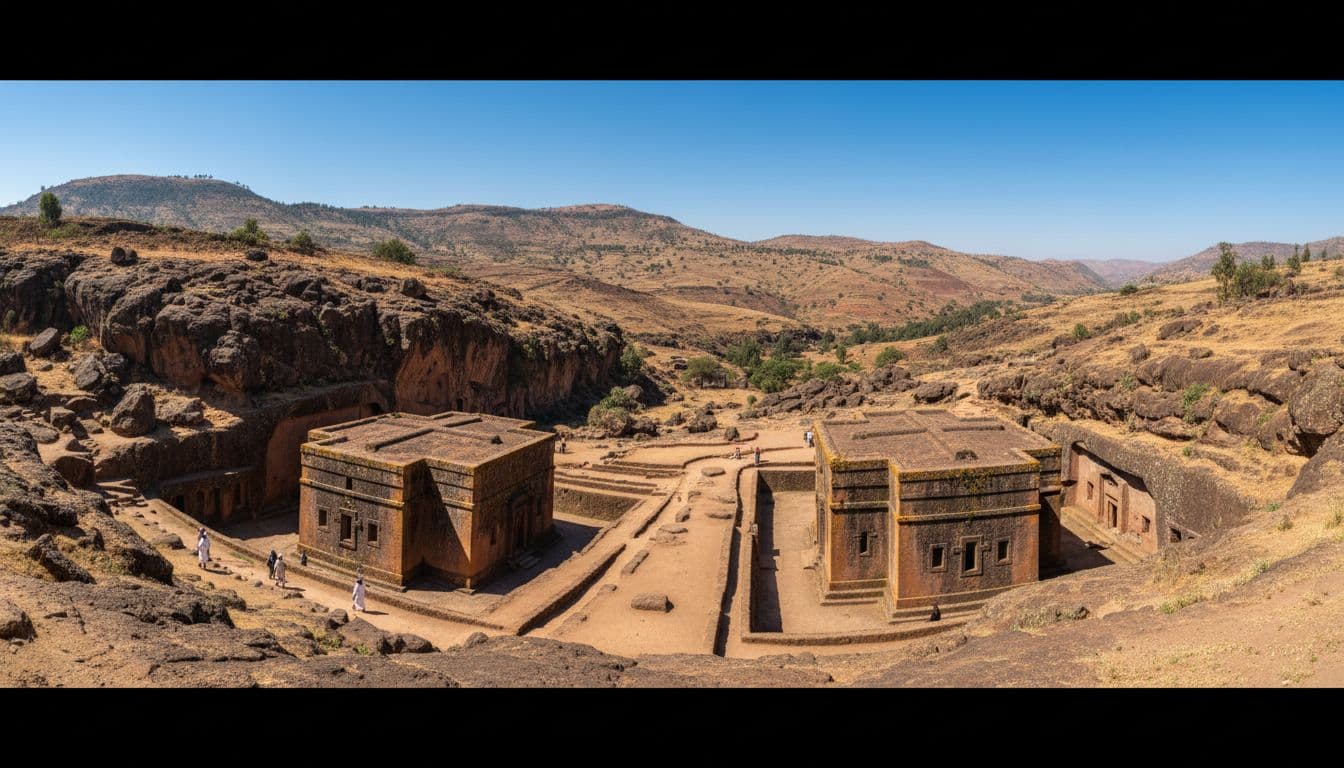
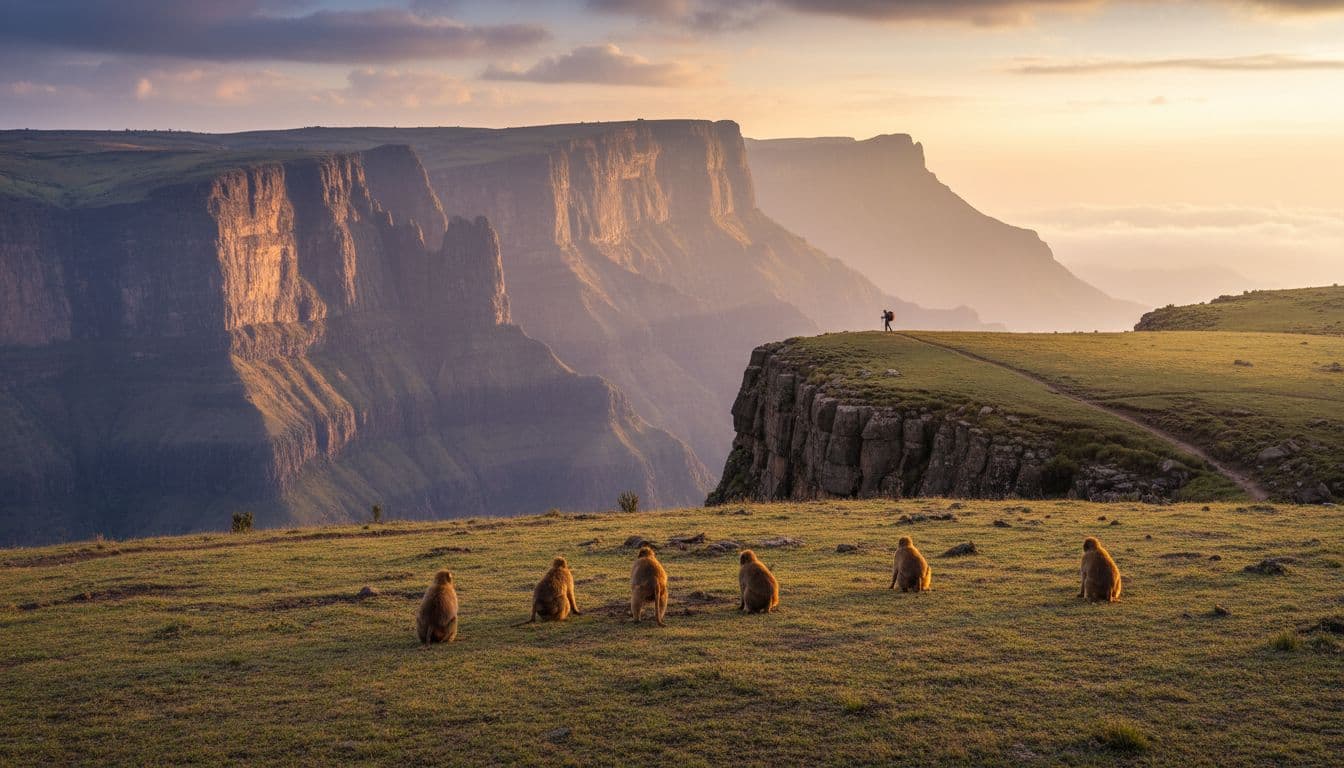
The classic first trip is the Northern Circuit, and it works because each stop has a clear "why."

Lalibela is all about the rock-hewn churches, carved down into the earth like architecture turned inside out. Gondar adds castles and royal history. Bahir Dar and Lake Tana bring boat trips to island monasteries, and the Blue Nile Falls can be worth it when water levels and access cooperate. Then the Simien Mountains deliver dramatic escarpments, fresh air, and wildlife like geladas.

Domestic flights can save your trip. Roads can be slow, and long drives stack up fast. If you're short on time, fly between Addis, Bahir Dar, Gondar, and Lalibela, then use local drivers for day trips. In the Simiens, plan for the usual park setup, which often includes an armed scout and required local support.

Iconic rock-hewn churches of Lalibela carved into red cliffs under a clear blue sky, wide landscape view with few distant pilgrims on paths in natural daylight.Dramatic cliffs and valleys in Ethiopia's Simien Mountains feature a small group of gelada baboons on a grassy plateau, with a single hiker visible on the trail in the distance under golden hour sunlight.### Optional adventure add-on, Danakil Depression, what it's like and who should skip it

Danakil is raw and intense. Expect extreme heat, basic camping, and guided 2 to 3 day tours. People go for Erta Ale's volcano and the surreal colors around Dallol, usually by 4WD convoy with a reputable operator. It's not a casual add-on, and it's not where you want to "figure it out as you go."

Skip it if:

  • You struggle in heat or have health concerns made worse by heat.
  • Your schedule is tight and you can't afford delays.
  • You prefer comfortable hotels and easy logistics.

A gentler swap is adding nights in Addis or the north, or slipping in a southern lake town like Awassa if your flights and time allow.

Sample 7 to 10 day Ethiopia itinerary for first-time visitors

Here's a realistic structure that keeps the pace manageable:

  • Days 1 to 2: Addis Ababa (museum, cathedral, coffee, logistics day)
  • Day 3: Fly to Bahir Dar (Lake Tana boat trip)
  • Day 4: Gondar (castles and historic sites)
  • Days 5 to 6: Simien Mountains (short trek or scenic hikes with park team)
  • Day 7: Fly to Lalibela
  • Day 8: Lalibela (churches, plus a slower afternoon)
  • Days 9 to 10: Optional Danakil, or a buffer day and return to Addis

Two rules keep stress low: build one buffer day for flight or road changes, and don't move every single day if you want a calmer trip.

Getting around, costs, money, packing, and cultural etiquette that helps you fit in

Transportation in Ethiopia, flights vs minibuses vs private drivers

Domestic flights are the fastest way to cover the northern route, especially in peak season. Book key legs early and double-check luggage limits, since smaller allowances can surprise first-timers.

Minibuses cost less, but they can be crowded and slow. A private car with a driver costs more, yet it's often easier for comfort and for safer night arrival planning. For Simien and Danakil, organized tours or structured park logistics usually make the most sense.

Money, budgets, and paying for things day to day

Ethiopia uses the Ethiopian Birr (ETB). ATMs are most reliable in larger cities like Addis Ababa, and card acceptance drops fast outside major hotels. Bring some USD or EUR cash for exchange, and keep small bills for tips and markets.

Daily costs vary by style, but a practical range for many first-time visitors is budget travel at about $50 to $90 per day, and mid-range travel at about $100 to $200 per day, before big extras. The biggest trip costs tend to be domestic flights, multi-day trekking support, and Danakil-style tours.

What to pack and what to wear, from highland nights to hot lowlands

Think in layers. Bring a light base layer, a warm evening layer for highlands, and comfortable walking shoes (or hiking boots for Simien). Add sun protection, a simple rain shell in shoulder months, a power bank, and plug adapters (Type C and F are common). Insect repellent and basic meds help, and a scarf or modest wrap makes church visits easier.

Keep valuables simple. A crossbody bag that zips beats a back pocket every time.

Food and cultural etiquette, coffee ceremonies, church rules, and photo manners

Ethiopian food is hearty and social. Try injera with stews (doro wat is a classic), tibs, and the many lentil and veggie dishes that make eating well easy. Coffee culture runs deep, so say yes when someone offers a ceremony.

Use your right hand for eating or greeting when possible. Dress modestly at religious sites, remove shoes where required, and ask before photographing people. If you don't love heat, request milder dishes and go easy on extra berbere until you learn your comfort level.

Conclusion

A great first trip to Ethiopia comes from a few smart choices: travel in the easier weather window (often October to March), confirm visa rules and current advisories right before departure, and build a north-focused route with a buffer day. Decide early whether Danakil truly fits your time, health, and comfort level.

Most importantly, slow down enough to enjoy the small moments, especially coffee ceremonies and conversations. Hire local guides when needed, follow local updates, and let Ethiopia surprise you in the best ways.